Lisbon

The Insignia docked in Lisbon Friday afternoon. The end of our sail across the Atlantic.

Lisbon is old. Really old. In fact, it’s one of the oldest cities in Western Europe—believed to be several centuries older than Rome.

During the Age of Exploration, Portuguese sailors like Vasco de Gama and Ferdinand Magellan launched from Lisbon to Africa, Brazil, India, and beyond. At one point Portugal controlled one of the world’s largest empires.

Kris and I got off the ship as quickly as possible to see what we could see.

We wandered uphill through the Alfama district, the postcard version of Lisbon: narrow alleys, laundry hanging overhead, tiled buildings, tiny bars, and random scenic overlooks around nearly every corner.

We had one more night of free food and booze on the ship, so, naturally, we took advantage of that after our 5-mile stroll.

Saturday morning, we had to be off the ship by 8:30. The previous afternoon, we had met a random taxi driver and arranged for him to pick us up at the cruise terminal for a four-hour tour to Sintra. Maybe not the safest travel strategy, but we obviously survived.

Sintra was the summer escape for Portuguese royalty. For centuries, kings and nobles fled Lisbon’s summer heat for the cooler hills and forests of the region. Think royal playground meets fantasy novel setting.

Our first stop was Pena Palace. We didn’t have time to tour the interior, but we walked the terraces and took in the colorful exterior and sweeping viewpoints. If Dr. Seuss had designed a European castle, it might’ve looked something like Pena Palace. The place almost looks fake in person.

We then headed down to the village of Sintra, which poet Lord Byron visited in the early 1800s and described as a “glorious Eden.” That romantic reputation helped make Sintra famous across Europe. It’s also now one of the most overcrowded places in Portugal.

After strolling through town, we made our way to Quinta da Regaleira, considered by many to be the most fascinating estate in Portugal, with underground tunnels, hidden grottoes, spiral wells, and mysterious occult symbolism. Unfortunately, with limited time, we only explored the grounds from the outside.

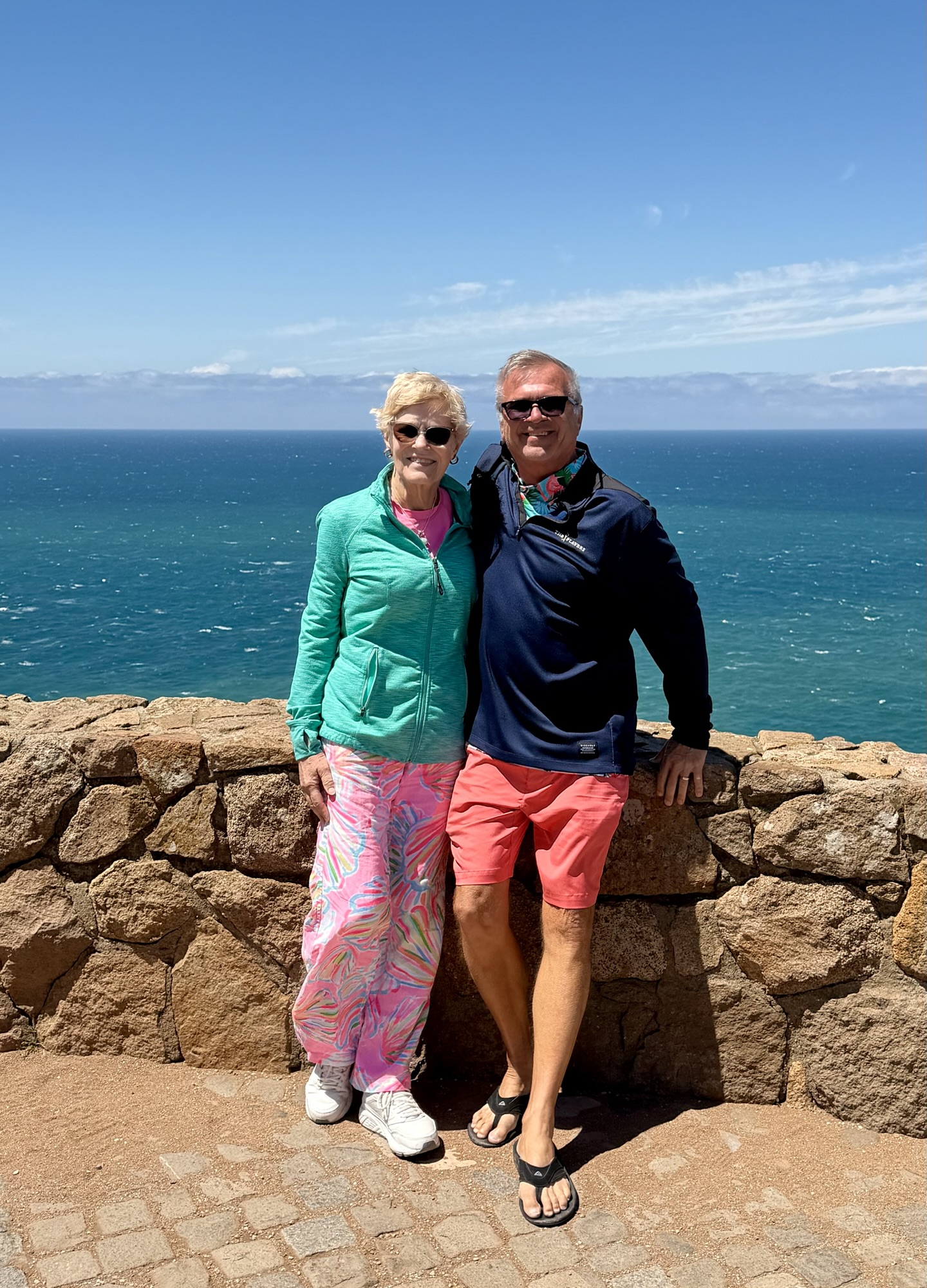
Our final stop was Cabo da Roca, the westernmost point of mainland Europe.

“Where the land ends and the sea begins.”

The cliffs were stunning. The wind was ridiculous. But there’s something about standing at the edge of a map that feels pretty cool.

We definitely didn’t spend enough time in the Lisbon area. Sintra alone deserves a full day. Lisbon is fun, unique, and easily worth at least two or three days.

Tomorrow we head to Porto for another quick stop. Over the next couple of weeks, we’ll be visiting some of my favorite towns from the Camino.

Should be fun.

Come along.

Just Pete.

Azores

After leaving Bermuda, we spent four days and five nights crossing the Atlantic. That’s a long stretch at sea, but Kris and I don’t mind as long as the ocean behaves itself. Besides, cruise ships make suffering manageable with unlimited food, booze, and entertainment.

Our destination was the Azores, a Portuguese archipelago in the middle of the Atlantic Ocean. Technically part of Europe, the islands sit about 900 miles west of Portugal and roughly halfway between Europe and North America. Because of that location, they were an important stop for ships crossing the Atlantic for centuries.

Our first stop was the island of Faial and the port city of Horta, one of the most famous sailing stops in the North Atlantic.

Horta has long been considered an iconic transatlantic sailing port. There’s even an old sailor superstition that boats skipping Horta have bad luck crossing the Atlantic. Whether that’s true or not… sailors don’t mess around with ocean karma.

We spent the day wandering the marina and town on a self-guided walking tour. Plenty of flowers, greenery, and ocean views.

Later that afternoon, we set out for São Miguel Island, the largest and most populated island in the Azores. The next morning we woke up in the beautiful harbor city of Ponta Delgada.

After getting off the ship, we hired a driver to take us across the island to the village of Sete Cidades. That meant crossing a volcanic mountain range to the other side of the island. Along the way, we experienced sun, rain, fog, wind, and blue skies. All before lunch.

The Azores are volcanic islands, and São Miguel is known for its crater lakes.

The most famous are the twin lakes at Sete Cidades. Years ago, the lakes were known for their distinct blue and green colors, although the contrast has faded over time. According to legend, the lakes were formed from the tears of separated lovers: one blue-eyed and one green-eyed. Romantic… and very Portuguese.

The island’s human population is around 160,000. The cow population? Roughly double that.

Most of them are dairy cattle, and one of the more unusual sights is the pasture fencing. In many places, the “fences” are actually hydrangea hedges. Apparently, there’s something about the plants the cows avoid. The hydrangeas also grow naturally along roads and hillsides. Unfortunately, they weren’t blooming this time of year, but when they do, the island is supposed to be spectacular.

The Azores were stunning. Some people call them the most underrated destination in Europe. After visiting, I can see why.

Next stop… Lisbon.

Bon voyage.

All Aboard

We boarded the Insignia in Miami on May 4 and set sail for Lisbon.

South Beach

Our first stop was Bermuda, sitting in the North Atlantic about 650 miles east of Cape Hatteras, NC. It took us three days at sea to get there.

Bermuda is made up of around 181 islands. Most are tiny and connected by bridges, so it feels like one continuous island stretching across bright turquoise water.

Insignia (top left) is the smaller ship. 650 passengers.

Color is everywhere in Bermuda. Brightly painted houses dot the landscape, and the beaches are just as striking. The famous pink sand comes from crushed coral and tiny marine organisms mixing with white sand.

It”s more pink than pic shows. Blame it on photographer!

We also found what’s believed to be the world’s smallest drawbridge. When a sailboat with a tall mast approaches, a friendly pedestrian manually lifts the bridge and guides the mast through. Only in Bermuda.

Of course, we had to stop at the Whitehorse Pub to try the local specialty: a fried fish sandwich on raisin bread. Fresh wahoo surrounded by coleslaw. Delicious.

After a day of exploring Bermuda, it was time to set sail once again.

Next stop: the Azores … after four more days at sea.

Bon voyage.